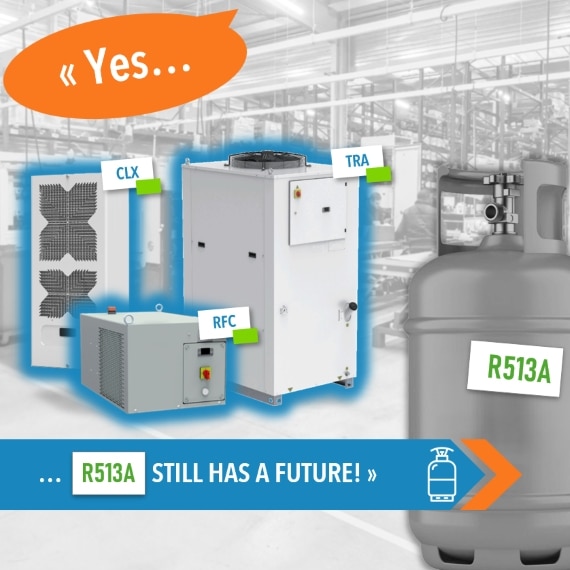
// R513A still has a future! //
At EURODIFROID, we are naturally at the forefront of regulatory requirements regarding refrigerants and F-Gas (notably with an increasing number of HFO-compatible units available across our various product ranges).
Yes indeed: R513A still has a future, as it offers a pragmatic, efficient alternative that remains viable across many industrial sectors.
That is why, at the start of the 2026 season, our CLX, RFC, and TRA ranges in particular are switching to the R513A refrigerant.
Based on feedback from our clients, this refrigerant is indeed particularly attractive for two main reasons:
- Normative compliance (and reduced climate impact);
- And a non-flammable solution (less complex, therefore less costly; and also suitable for sensitive sites).
Alongside our HFO air conditioners and chillers, the aim here is to expand our range of R513A solutions, which—under certain conditions—remain highly relevant for field applications.
Let us explain!
REMINDER: What is a refrigerant and what is its role?
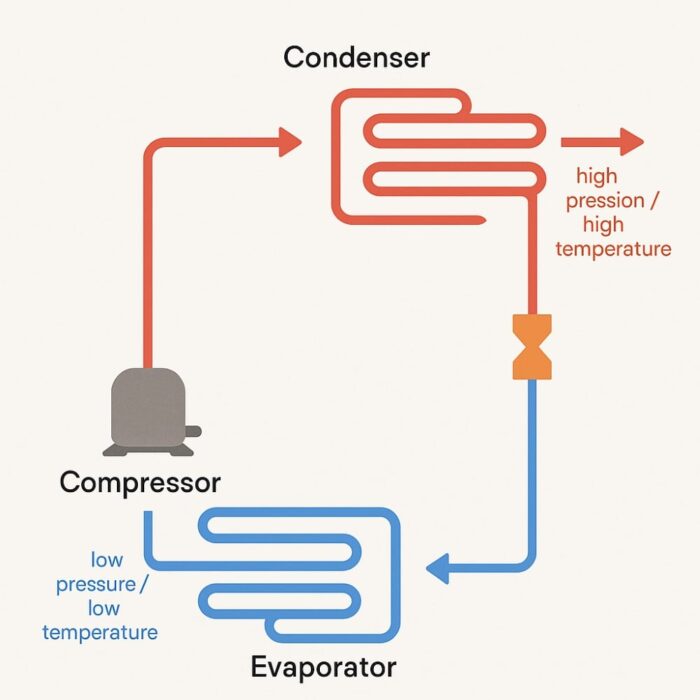
The refrigerant is an essential component of a refrigeration system’s operation. It circulates within the equipment in a closed loop, enabling the transfer of heat from one environment to another.
In a cabinet air conditioner or industrial chiller, the fluid absorbs heat at the evaporator and then rejects it externally at the condenser. This thermodynamic cycle—driven by the compressor and the various components of the refrigeration circuit—makes it possible to maintain the desired setpoint temperature for your cabinet, heat transfer fluid network, or industrial process.
The choice of refrigerant is therefore crucial. It must offer:
- Good thermodynamic performance (at the desired control temperatures);
- While meeting (sometimes specific) safety requirements;
- With a proven level of reliability;
- And in compliance with environmental regulations.
We do this using a pragmatic approach and an “industrial” mindset: our strength lies precisely in offering our clients solutions that are balanced from both a technical and economic perspective.
We collaborate with numerous industry partners (such as Bitzer and Sanyo) to source components that offer the best balance of quality, efficiency, and price.
We are also open to integrating other sources if your project requires a specific component.
Why switch to R513A?
R513A is an HFC/HFO blend developed as an alternative to R134a.
It offers similar thermodynamic properties, making it a particularly suitable solution for industrial cooling applications that use this refrigerant.
Indeed, the European Union explicitly identifies R513A as an alternative to R134a for cooling systems and air conditioning equipment.
Its main environmental advantage lies in its global warming potential (GWP), which is significantly lower than that of R134a.
Based on the values used in the European F-Gas Regulation 2024/573, R513A has a GWP of only 630, compared to 1,430 for R134a.
Switching to R513A thus makes it possible to significantly reduce the refrigerant’s potential climate impact, while maintaining a solution suited to the requirements of industrial applications.
Our approach? Listening to our clients.
For it is through the regular interactions we have with them that—depending on their sector of activity and their specific constraints—we develop product ranges utilizing various types of gases: whether involving strict regulatory or safety requirements, or special exemptions (such as might apply in the defense sector, for instance)…
Our business is tailoring the “right solution” to your needs.
A solution for anticipating regulatory changes
European F-Gas regulations mandate a progressive reduction in the use of refrigerants with high GWP*. This trajectory encourages manufacturers and users of refrigeration equipment to anticipate the transition to fluids with a lower environmental impact starting now.
The choice of R513A (already used on other of our refrigeration units) allows us to support this development and offer equipment designed to meet current and future regulatory requirements, while ensuring the continuity of performance expected by users.
Please note, however: barring any duly specified and documented safety risks, R513A refrigerant will not be compliant starting in January 2027… (see below)

The advantage of a non-flammable fluid
Another key advantage is that R513A is classified as A1 according to the safety classification documented by the INRS (National Research and Safety Institute).
Indeed, alongside the F-Gas regulation—which addresses environmental impact and usage restrictions—the ISO 817 standard defines refrigerant safety classification based on two criteria:
- Their toxicity:
- A = low toxicity
- B = higher toxicity :
- And their flammability:
- 1 = no flame spread
- 2L = low flammability and low burning rate
- 2 = flammable
- 3 = highly flammable
This results in classifications such as A1, A2L, A2, A3, B2L, B2, or B3.

This A1 classification for R513A (like that of CO2 or water) therefore means that it has low toxicity and is non-flammable under the conditions defined by the standard.
This aspect is particularly relevant in industrial environments. Unlike certain new refrigerants classified as A2L or A3, R513A does not require addressing the same constraints associated with refrigerant flammability.
For users, this offers a solution that combines reduced GWP*, operational safety, and technological continuity, without compromising the specific requirements of industrial installations.
Industrial cooling devices using R513A refrigerant therefore offer the advantage of complying with applicable European safety standards, notably:
- Directive 2014/34/EU (ATEX);
- EN 378 (Refrigeration systems and heat pumps – Safety and environmental requirements);
- EN 60335-2-40 (Safety requirements for electrical air conditioning and refrigeration appliances).
These requirements cover various aspects of product safety and must be considered in their entirety when assessing the suitability of the refrigerant for industrial enclosure cooling applications. Compliance with a standard does not exempt one from meeting all safety obligations applicable to the intended application.
What product developments are taking place at EURODIFROID?
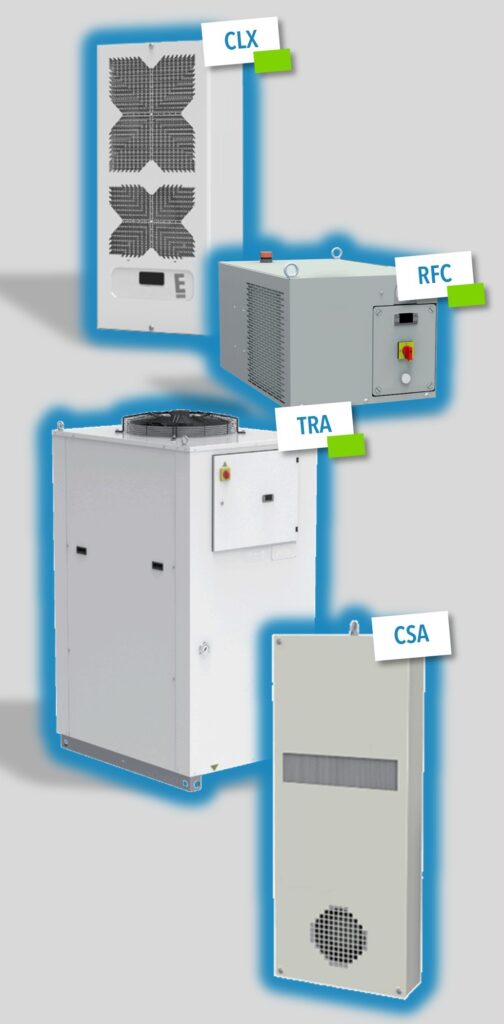
Our product changes (September 2026**)
- Cabinet AIR CONDITIONERS CLX
> All models are switching to R513A.
- Water or oil CHILLERS RFC
> 8/14/19 models switch to R513A
- Water or oil CHILLERS TRA
> 110/150/200/250 models switch to R513A (thereby complementing the 30/45/80 models that already use R513A)
> Switch to EC fans at proportional speed (110/150/200/250 models)
> And discontinuation of the TRA 180 model.
- Improvements also on our CSA AIR/AIR EXCHANGERS (for cabinet air conditioning):
> New connectors and mounting seals (see installation diagrams)
In practical terms: how do you choose the right refrigerant?
Please note that we are able to offer you different gases on our air conditioners and coolers (chillers):
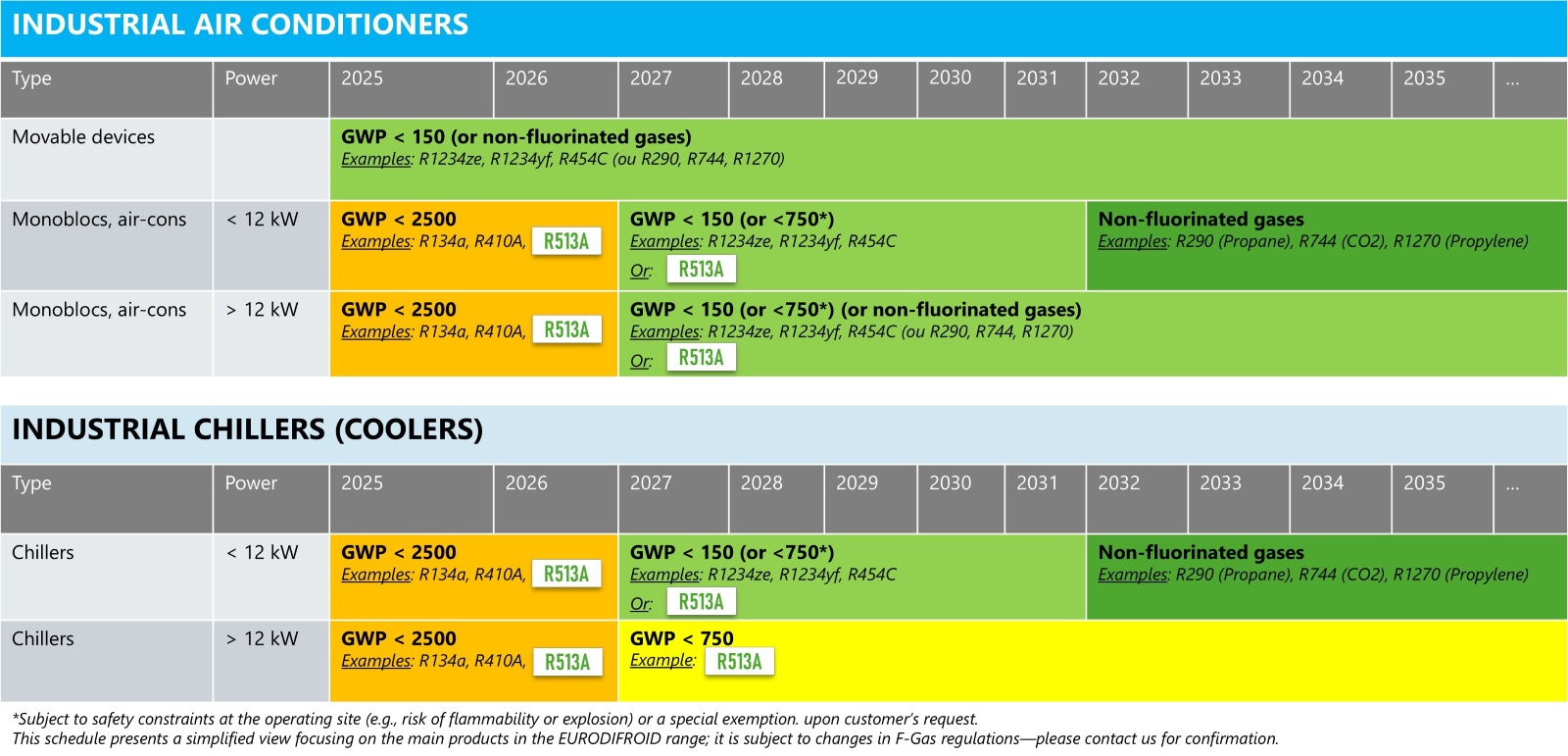
- We now offer a wide range of solutions using low-GWP* HFO gases (such as R1234ze or R1234yf) that fully comply with applicable standards (particularly for capacities under 12 kW, which become mandatory starting in January 2027);
- But we also maintain ranges equivalent to R513A gas which, depending on the safety requirements required on the site, can provide a reliable and compliant response ((or even other types of gas, depending on your needs).
Therefore, depending on whether the site strictly requires non-flammable fluids (as defined by F-Gas regulations), it is essential to specify this in your request (a dedicated form is available) so that a solution compliant with local regulations can be selected.

Your F-GAS roadmap***
The easiest way?
Send us your requirements or specifications, as our experts are here to:
- Explain the standards applicable to your operations;
- Take into account all aspects of your installation—particularly safety considerations (based on the site’s permissible flammability level) and your specific requirements (such as refrigerants or specific components);
- To propose solutions that meet expected performance levels and operational requirements, accompanied by clear, comprehensive explanations that enable you to carry out your operations flawlessly.
*What is GWP?
GWP (Global Warming Potential) represents the ratio of a gas’s warming power to that of CO2, thereby indicating its contribution to the greenhouse effect.
Each refrigerant is assigned a GWP value, which allows its environmental impact to be assessed.
Example: The GWP of R410A is 2,100 (meaning it is 2,100 times more harmful than CO2), whereas the GWP of R1234yf is only 1.
Any further questions? Check out our “Questions and Answers“ section.
**If you would like confirmation regarding your order during this period, please contact our sales department.
***This is a simplified, non-exhaustive table, as special cases exist depending on device types, power ratings, regular updates, etc.;: please contact us for further details regarding your specific project.
Released on: September/14th/2026
We’re also being talked about elsewhere on the web too: EURODIFROID on Google News