
// Industrial chiller: how to choose? //
How do you choose the right industrial chiller (water cooling, oil cooling…)? That is THE QUESTION of the day!
In many industrial sectors, temperature control is a key factor for performance, quality, and safety.
Whether you operate in the agri-food, research, renewable energies, medical, or machine-tool manufacturing sectors, selecting your industrial chiller—whether for water, glycol-water, oil, or any other liquid or viscous mixture—requires a methodical approach.
Then:
- Which water (or oil) industrial chiller should you choose?
- What factors should be considered when selecting a chiller unit?
- What mistakes should be avoided when looking for an industrial chiller unit?
Some answers below!
The short answer
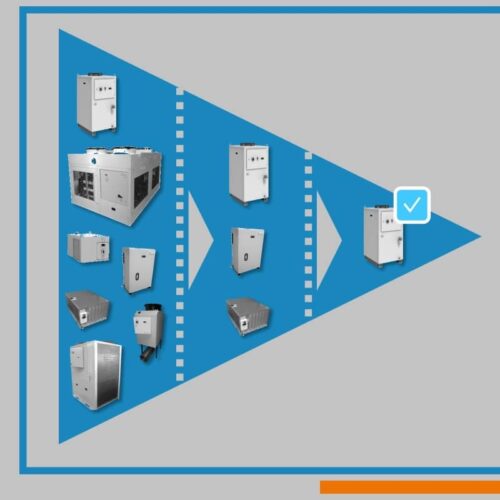
Determining the right cooler for your needs essentially involves 3 steps:
- Define your thermal requirements: what needs to be cooled and the required temperature range;
- Consider the constraints of your operations: potential primary cooling sources (e.g., chilled water network), installation feasibility (available space, distance and layout, power supply type), and applicable standards (particularly regarding refrigerants, as well as resistance to dust or corrosion);
- And factor in your operational needs or objectives: integration and interaction with other equipment, targets for energy and maintenance costs, and the technical skill level of your teams…
The article below provides further insight into the vast world of industrial coolers (also sometimes referred to by the English term “chiller”).
However, if you have any doubts, rest assured: supporting you and anticipating all these factors is precisely the role of EURODIFROID’s technical teams.
Send us your information (description of the need, photo, specifications, device to be replaced or any other data or question, etc.) and our teams will quickly offer you a first concrete and costed approach.
Precisely define thermal requirements

The first step involves conducting a thorough analysis of the process’s thermal requirements. This phase is generally entrusted to a design office or an engineer specializing in industrial refrigeration systems.
Sending a request to EURODIFROID means taking advantage of a complete engineering office which provides expertise on various points: mechanics, hydraulics, refrigeration, electrical and regulation…
Several criteria must be analyzed:
- Required cooling capacity (the goal being to size the right solution for the specific cooling needs);
- Inlet and outlet temperatures (the difference between these two values provides a good indication of the required cooling capacity);
- Nature of the cooling fluid (water, water-glycol mixture, oil, blend, emulsion, specialized fluid, etc.—we take into account the fluid type, viscosity, thermal inertia, etc.);
- Environmental conditions (temperature range and fluctuations, as well as available space, dust, salinity, accessibility, etc.);
- Future system upgrades (an often-overlooked factor; if you are planning additions or modifications to your process, it is best to size the chiller accordingly).
An undersized industrial chiller will lead to malfunctions, whereas oversized equipment will result in excessive energy consumption.
Cooler or heat exchanger?
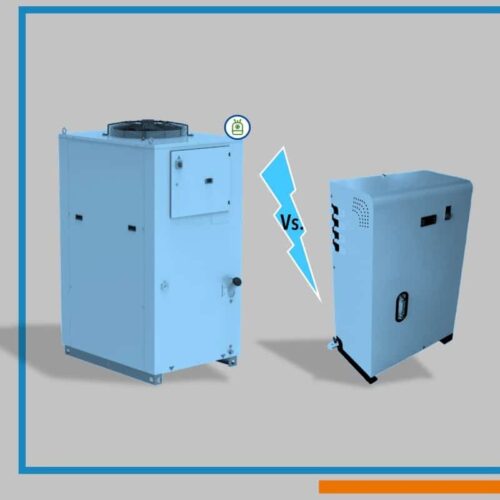
In many cases, this is a choice made out of necessity:
- If your site has a sufficiently stable primary cold source (such as a chilled water loop or cold air supply), it may be worth considering a heat exchanger—such as a water-to-water exchangers or air-to-water exchangers—to leverage this existing source and eliminate the need for a dedicated refrigeration circuit.
- Unfortunately, the most common scenario requires a unit capable of generating cooling independently. This necessitates a system equipped with a complete refrigeration circuit that cycles a refrigerant through various states (alternating between compression and expansion); this process, combined with the refrigerant’s thermodynamic properties, enables cooling by rejecting excess heat from the hydraulic circuit.
At EURODIFROID, this type of industrial unit is known as an “active chiller.” While more expensive to manufacture and maintain, these units offer the significant advantage of providing reliable, on-demand cooling—independent of any external primary source—with full efficiency and no interruptions.
Industrial water chiller vs. glycol-water chiller?
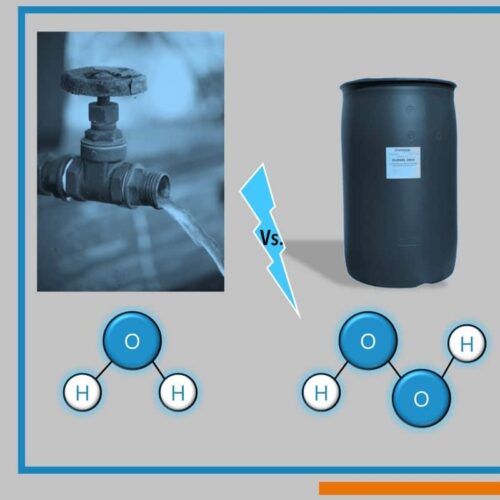
The choice between pure water (cold or chilled water) and glycol (or glycol-water mixture) depends primarily on operating temperatures.
Installations operating at low temperatures generally use a brine circuit to avoid the risk of freezing and to guarantee continuity of production.
Glycol-water chillers are particularly common in the food processing industry and in certain sensitive industrial processes (such as aerospace and hydrogen).
The importance of energy efficiency
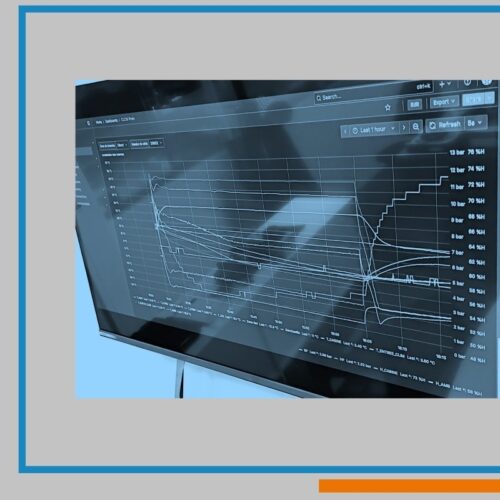
Today, energy savings are a key criterion when selecting a commercial or industrial chiller.
New industrial chiller units use high-efficiency components and refrigerants (also referred to as refrigerant gases) with low environmental impact.
R513A, for example, is currently widely used, even though F-gas regulations will—in the short or medium term—mandate the replacement of this refrigerant with gases that are increasingly environmentally friendly.
We are therefore increasingly offering refrigeration circuits that operate using HFO (hydrofluoro-olefin) refrigerants—such as R1234yf or R1234ze—which have a lower GWP (Global Warming Potential).
Beyond the choice of refrigerant, we also offer technical features designed to significantly optimize the efficiency of our units—such as free cooling, micro-channel technology, and variable-speed pumps or fans.
Optimizing energy performance enables a lasting reduction in operating costs.
Choosing a custom industrial chiller
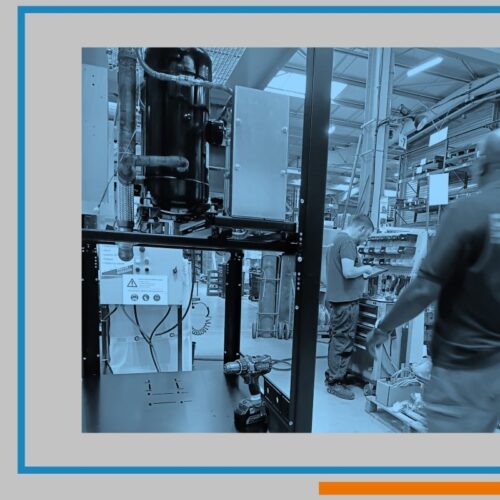
Every process has its own specific requirements. That is why companies and professionals are increasingly seeking custom industrial cooling solutions.
In practical terms, a water or oil cooler often needs to be integrated into an industrial process, machine tool, or piece of technical equipment, subject to constraints that vary significantly from one company to another (size and dimensions, accessibility, hydraulic interfacing, programming and data exchange, etc.).
At EURODIFROID, the design and manufacturing teams develop refrigeration systems tailored to the specific requirements of each industrial client. These teams work together at our production site in France, near Angers (49 France).
In this regard, the RFI chiller ranges are perfect examples illustrating this ability to design robust, high-performance equipment tailored to the cooling needs of industrial processes.
Our water-cooling RFIs (ranging from 3 to 250 kW in capacity) are also available as RFIH models (specifically designed to cool oil or more viscous mixtures) and offer numerous options (outdoor versions, variants without a tank and/or pump, stainless steel construction, special paint finishes, etc.).
THE QUESTION we are asked most often
“What industrial chiller capacity do I need for my installation?”

This is probably the most frequently asked question directed at our technicians and engineers specializing in industrial refrigeration units.
The answer is simple: there is no universal answer.
Sizing an industrial cooler (for water, oil, or any other liquid) depends on multiple factors, including:
- The thermal power generated by the process;
- The flow rate of the water (or glycol-water, mixture, oil, food paste, etc.);
- The desired temperature;
- Ambient conditions;
- Future changes in production.
At EURODIFROID, every project undergoes an analysis by the engineering department to prevent sizing errors. A custom-made industrial chiller is often more cost-effective than ill-suited standard equipment.
For example, the RFI and RFIH chiller ranges make it possible to optimize performance while reducing energy consumption, thus helping you lowering operating expenses.
The critical point that must never be overlooked
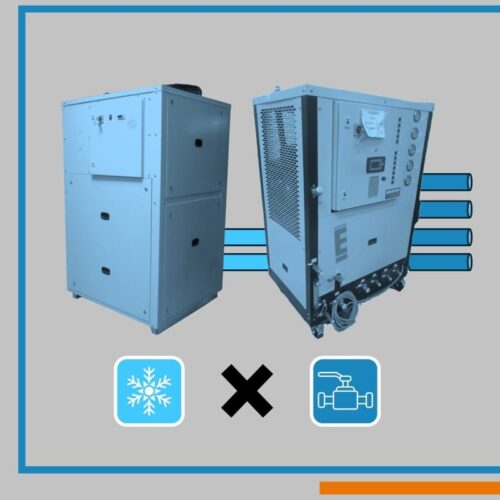
Many manufacturers focus their attention on cooling capacity and overlook an essential element: the quality of the hydraulic circuit.
Incorrect sizing of pumps, valves, sensors, piping, fans, or buffer volume can significantly impair the performance of the water or oil chiller.
The consequences can be significant:
- Excessive electricity consumption;
- Temperature instability;
- Frequent start/stop cycles;
- Premature compressor wear;
- Higher maintenance and running costs.
That is why an industrial cooling project must always be approached holistically: industrial chiller units, hydraulics, automation, control systems, and system maintenance.
In some cases, we supplement the cooling unit with a hydraulic management unit: a skid (commonly referred to as a hydraulic skid or sometimes a piping skid).
This hydraulic skid will be dedicated entirely to controlling fluid circuits (water, oil, mixtures, etc.), enabling more precise management—for instance, across multiple workstations or for specific operations.
Thus, each function (generating cooling via the industrial chiller and controlling flow across various circuits via the skid) utilises a dedicated unit, resulting in a system far better suited to heavy-duty use.
The proper functioning of your process (its cooling and hydraulic performance, as well as its longevity) is therefore based on a precise analysis of needs, energy constraints and production objectives.
Engaging an industrial refrigeration company with an in-house engineering department, such as EURODIFROID, helps secure the project and ensures a solution perfectly tailored to the installation’s current and future needs.
The choice of your supplier must therefore also take into account their level of expertise, their knowledge of your sector of activity and its constraints, their capacity for industrialization and integration, and their service offerings as well as their proximity.
Released on: August/25th/2026
We’re also being talked about on the web: EURODIFROID on Google News