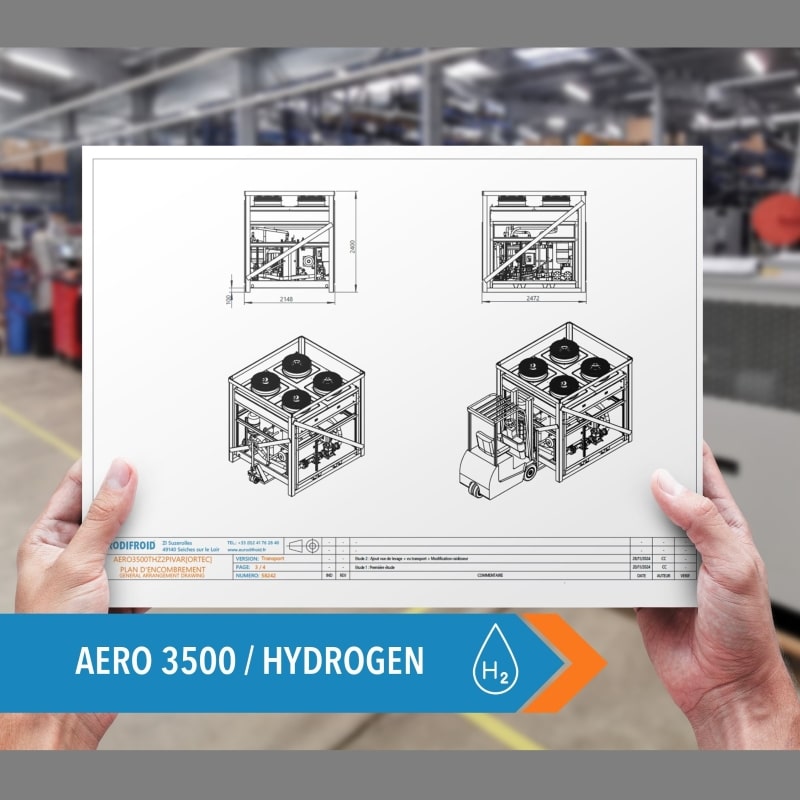
// AERO 3500 exchanger for hydrogen station //
Design of a cooling unit (air/water heat exchanger) for a hydrogen station
It takes a lot of steps for a project like this!
Below, in pictures: conception/design, procurement and assembly, factory testing and adjustments, delivery and integration at the client’s site…
It took several months for the collaborative work between us and the client to materialize into a first unit.
But for a cooling heat exchanger of this size (nearly 1,200 kg!), and to meet the ambition of ORTEC, which is planning a large-scale deployment of hydrogen stations across Europe, we definitely have to “raise the bar”!
What is this AERO 3500 exchanger?
Our AERO3500 device is part of our cooling solutions: it is an air/water exchanger, specially designed to be integrated into the Hydrogen station developed by the Client.
In this article, we illustrate some stages of this project: assembly, testing, then integration into the final chassis.
To describe it in a few key points:
- 360 kW of cooling power for an air inlet of 40°C, and a 35% glycol water outlet of 60°C;
- a “cooling” loop with 4 fans, 1 variable-speed pump, 1 3-way valve with servomotor, etc.;
- and a “battery” loop with 1 variable-speed pump;
- all controlled by a control cabinet with an Eliwell Free Advance PLC (with fan and pump speed control, ModBus TCP/IP communication, read/write of setpoints, etc.);
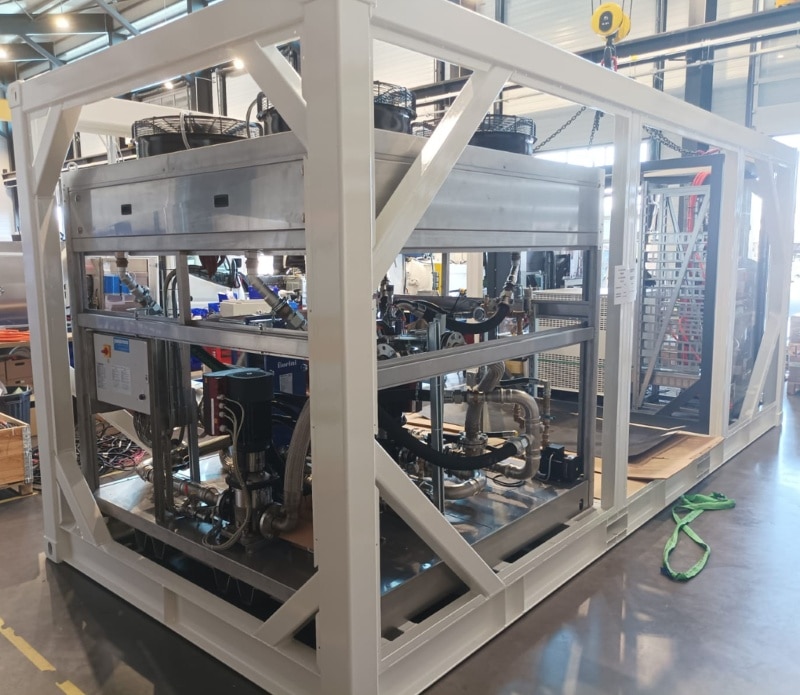
- to be integrated into a streamlined monobloc chassis, which must itself be integrated into a shelter and efficiently connect to all the module’s inputs/outputs.
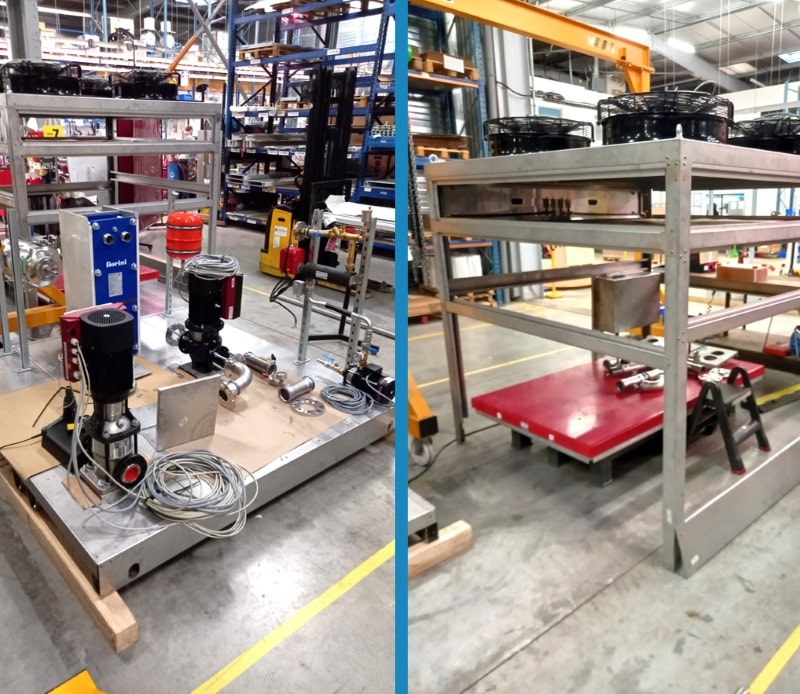
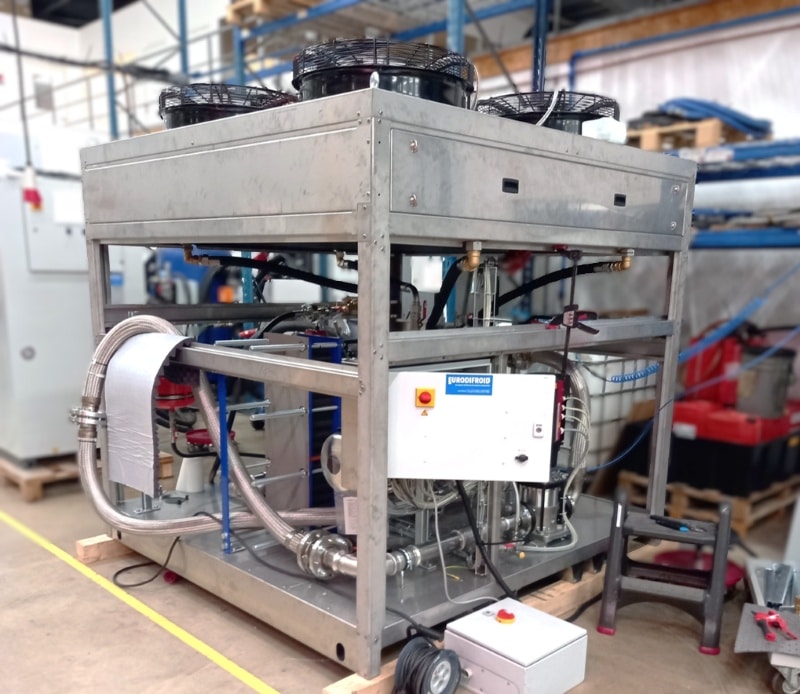
The first AERO3500 of this type is now ready for commissioning in England.
The EURODIFROID teams are also ready to embark on a new phase: industrial production (mini-series batches).
(here in picture: the unit testings at our factory)
This business case perfectly illustrates our ambition for the future: to support our Clients’ project teams on the design-qualification aspects of the refrigeration part, while offering an industrialization capacity for series/batch production or deployment of machine parks.
(here in picture: the integration of the AERO 3500 in the customer’s frame)
Whatever your technical project, entrust us with the “cooling” part: it’s our job!
- Do you also need a refrigeration unit to integrate into an industrial solution?
- Are you planning series production or large-scale deployments?
- Are you looking for a specialist partner in climate engineering and cooling units to support your ramp-up?
More information: what is glycol ?
Glycol is a type of alcohol commonly used as a heat transfer fluid in heating, ventilation, air conditioning, and refrigeration (HVAC-R) systems.
There are two main types of glycol used in cooling systems:
- Ethylene glycol (EG): very efficient from a thermal and fluidity point of view, but unfortunately quite toxic;
- Propylene glycol (PG): more viscous, it is also slightly less efficient. However, it is better suited for certain uses, such as food processing, pharmaceuticals, etc.
Most often mixed with water (the glycol content of the mixture is then expressed as a percentage), glycol forms an antifreeze solution which circulates in the cooling system.
Its main functions are:
- Lowering the freezing point: Glycol prevents water from freezing in pipes at low temperatures, which could damage equipment.
(Example: A 50% glycol solution can protect down to approximately -35°C.) - Raising the boiling point: It also allows the fluid to operate at higher temperatures without boiling, useful in some industrial systems.
- Preventing corrosion: Glycol solutions often contain corrosion inhibitors that protect metal components (such as aluminum, copper, or steel) from rust.
- And finally, improving heat transfer: Even though pure glycol has a lower heat capacity than water, it remains effective as a heat transfer fluid in demanding environments.
It is therefore naturally found in many “cold” devices: industrial and commercial cold units, coolers (or chillers) for cooling buildings or machines, process cooling systems (e.g.: breweries, laboratories), etc.
Released on: June/18th/2025
We’re also being talked about elsewhere on the web too: EURODIFROID on Google News